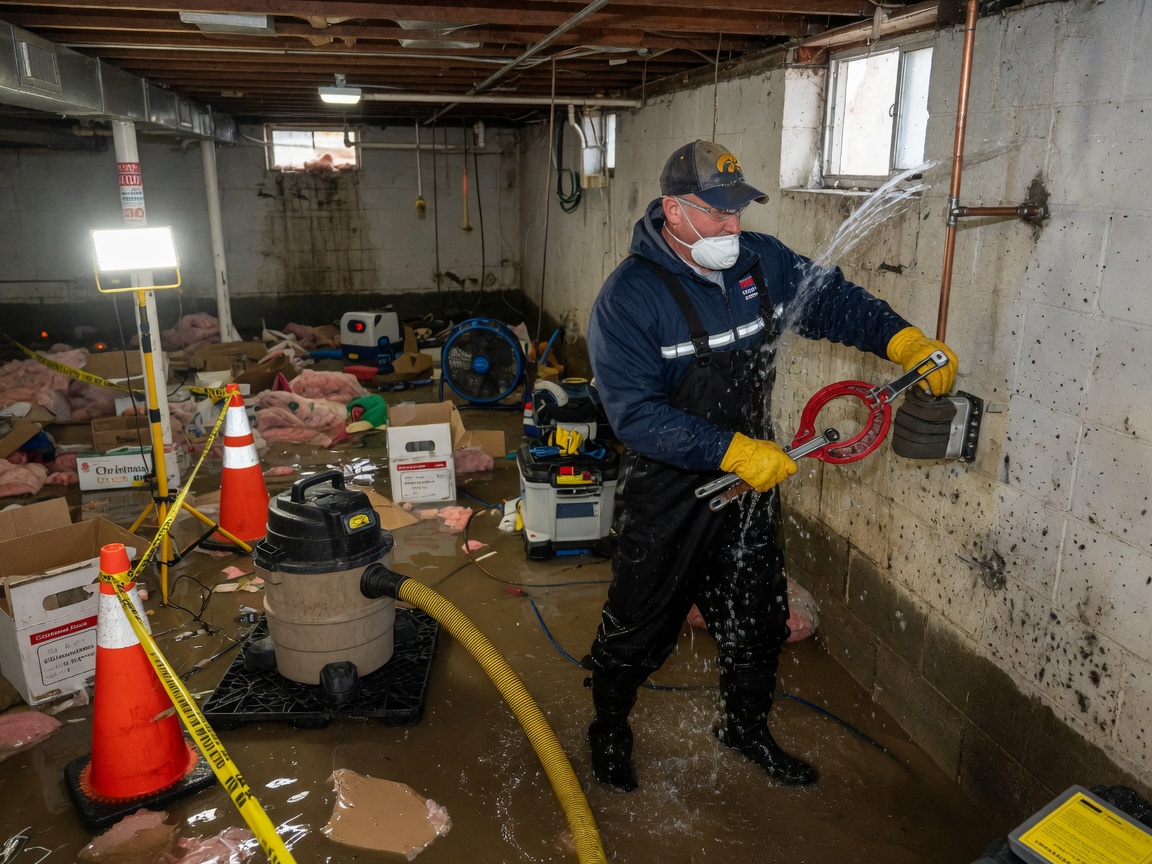
Cedar Rapids homes built before 1970 in Czech Village and Downtown often contain galvanized or copper supply lines that corrode from decades of mineral-rich well water drawn from the Cedar River aquifer. When these lines burst, water can migrate through plaster lath walls and into balloon-framed floors, saturating insulation and subfloors that are difficult to access without removing baseboards or sections of hardwood. Winter temperatures that drop below zero for days cause contraction and joint failure even in heated spaces, especially in Northwest Cedar Rapids bungalows with uninsulated crawl spaces.
After shutting off the main valve we extract standing water with truck-mounted units rated for 500-plus gallons per hour, then place air movers and dehumidifiers sized for the square footage and ceiling height typical of two-story Linn County residences. Moisture meters track hidden pockets behind brick veneer common in Southeast Cedar Rapids and along the NewBo District commercial conversions. We document every reading so homeowners can show insurers the exact moisture levels that remain after drying.
In homes near Brucemore or Hawkeye Downs where finished basements sit below grade, burst pipes frequently push water under sill plates and into adjacent drywall. We remove only the minimum material needed for airflow while preserving original trim whenever possible, then apply antimicrobial treatments to studs that have been wet longer than 48 hours. Final verification includes thermal imaging to confirm no residual moisture remains before walls are closed.
Technician insight
In Cedar Rapids the thing that catches most people out with burst pipe cleanup is how quickly water travels under the wide plank subfloors of 1920s homes in Czech Village and NewBo when a supply line lets go during a January freeze; once it reaches the dirt crawl space the job doubles because you have to pull more flooring to get airflow underneath.
Northwest Cedar Rapids Bungalow Freeze
A main-floor supply line split during a week of sub-zero temperatures. Water ran under the oak floor into the uninsulated crawl space and wicked up into the kitchen drywall. We extracted the standing water, placed targeted drying under the floor joists, and monitored readings for four days until levels matched the rest of the home.
Burst Pipe Cleanup Services We Offer
✓Frozen Pipe Burst Repair
Locate and isolate sections of pipe that split during cold snaps, then restore flow while protecting surrounding finishes in unheated Cedar Rapids basements.
✓Basement Water Extraction
Remove standing water from below-grade spaces common in Northwest and Southeast Cedar Rapids homes before it reaches electrical systems or HVAC equipment.
✓Wall Cavity Drying
Create access points and install drying equipment behind plaster or drywall to prevent hidden mold growth after pipe failures in older Linn County housing.
✓Hardwood Floor Restoration
Lift and dry cupped boards in NewBo District and Czech Village homes where water migrates under tongue-and-groove flooring from upper-level bursts.
✓Ceiling Leak Containment
Support sagging drywall and extract water from above ceilings in two-story homes near the Cedar Rapids Museum of Art before structural weakening occurs.
Burst Pipe Cleanup Cost in Cedar Rapids, IA
| Service | Typical Range | What Affects It |
|---|---|---|
| Initial assessment and water extraction | $350–$750 | Varies by number of rooms and whether crawl space access is needed |
| Daily drying equipment rental | $125–$225 per day | Based on equipment count required for older Cedar Rapids construction |
| Wall cavity drying add-on | $200–$450 | Includes creating access points in plaster walls |
| Hardwood floor drying | $300–$600 | Depends on square footage and cupping severity |
Ranges are typical for Cedar Rapids, IA and confirmed with an exact written quote before any work starts.
How it works
- 1
Immediate Response
Answer the 24/7 call, dispatch a technician to the Cedar Rapids address, and guide the homeowner through shutting off water if safe to do so.
- 2
On-Site Assessment
Map the source, test moisture levels in affected rooms, and identify migration paths through floors common in Linn County older stock.
- 3
Water Removal
Extract standing water and set up drying equipment sized for the home's construction type and square footage.
- 4
Drying Verification
Monitor readings daily until levels match unaffected areas, then document results for insurance submission.
Pricing
Upfront written estimates provided after inspection; final cost depends on water volume, affected square footage, and whether hardwood or plaster must be removed.